Linear Regression
Wednesday, May 27
Today we will…
- Group Quiz 8
- New Material
- Review of Simple Linear Regression
- Assessing Model Fit
- Work Time
- Lab 9: Regression Exploration
- Group Project
Project Notes
- They are coming together nicely!
- Look at Quarto documentation and the source code for our labs to see how to do quarto styling
- links
- callouts
- LaTeX
- code font (
summarize())
- This is a final project – I expect clean work and evidence of effort
Simple Linear Regression
NC Births Data
This dataset contains a random sample of 1,000 births from North Carolina in 2004 (sampled from a larger dataset).
- Each case describes the birth of a single child, including characteristics of the:
- child (birth weight, length of gestation, etc.).
- birth parents (age, weight gained during pregnancy, smoking habits, etc.).
NC Births Data
| fage | mage | mature | weeks | premie | visits | marital | gained | weight | lowbirthweight | gender | habit | whitemom |
|---|---|---|---|---|---|---|---|---|---|---|---|---|
| 19 | 15 | younger mom | 37 | full term | 11 | not married | 38 | 6.63 | not low | female | nonsmoker | white |
| NA | 28 | younger mom | 38 | full term | 10 | married | 70 | 8.19 | not low | male | nonsmoker | white |
| 55 | 46 | mature mom | 31 | premie | 8 | married | 25 | 4.56 | low | female | nonsmoker | not white |
| 36 | 37 | mature mom | 44 | full term | 10 | married | 25 | 8.94 | not low | male | nonsmoker | white |
| NA | 30 | younger mom | 39 | full term | 10 | not married | 38 | 11.75 | not low | male | nonsmoker | white |
| 26 | 23 | younger mom | 40 | full term | 14 | married | 28 | 8.38 | not low | male | nonsmoker | white |
| 40 | 34 | younger mom | 39 | full term | 15 | married | 20 | 6.38 | not low | male | nonsmoker | not white |
| 27 | 26 | younger mom | 39 | full term | 16 | married | 38 | 8.00 | not low | female | nonsmoker | white |
| 24 | 24 | younger mom | 38 | full term | 17 | not married | 13 | 6.56 | not low | female | nonsmoker | not white |
| 34 | 36 | mature mom | 37 | full term | 14 | married | 40 | 8.81 | not low | male | nonsmoker | white |
Relationships Between Variables
Relationships Between Variables
In statistical models, we generally have one variable that is the response and one or more variables that are explanatory.
- Response variable
- Also: \(y\), dependent variable
- This is the quantity we want to understand.
- Explanatory variable
- Also: \(x\), independent variable, predictor
- This is something we think might be related to the response.
Visualizing a Relationship
The scatterplot has been called the most “generally useful invention in the history of statistical graphics.”
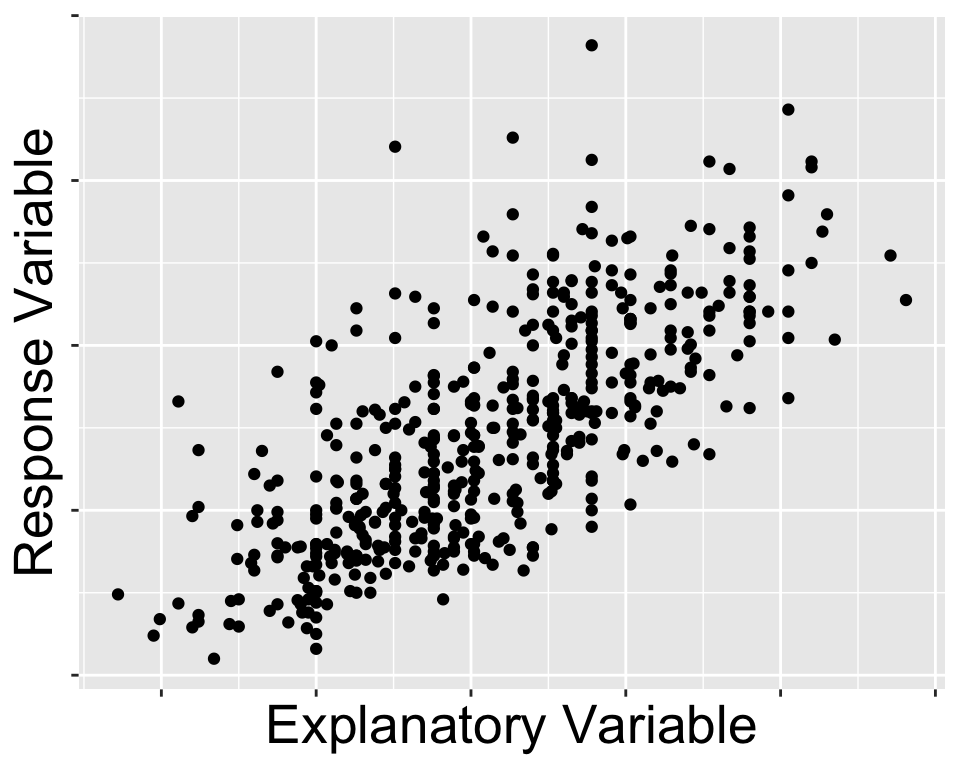
Characterizing Relationships
- Form: linear, quadratic, non-linear?
- Direction: positive, negative?
- Strength: how much scatter/noise?
- Unusual observations: do points not fit the overall pattern?
Your turn!
How would you characterize this relationship?
- Shape?
- Direction?
- Strength?
- Outliers?
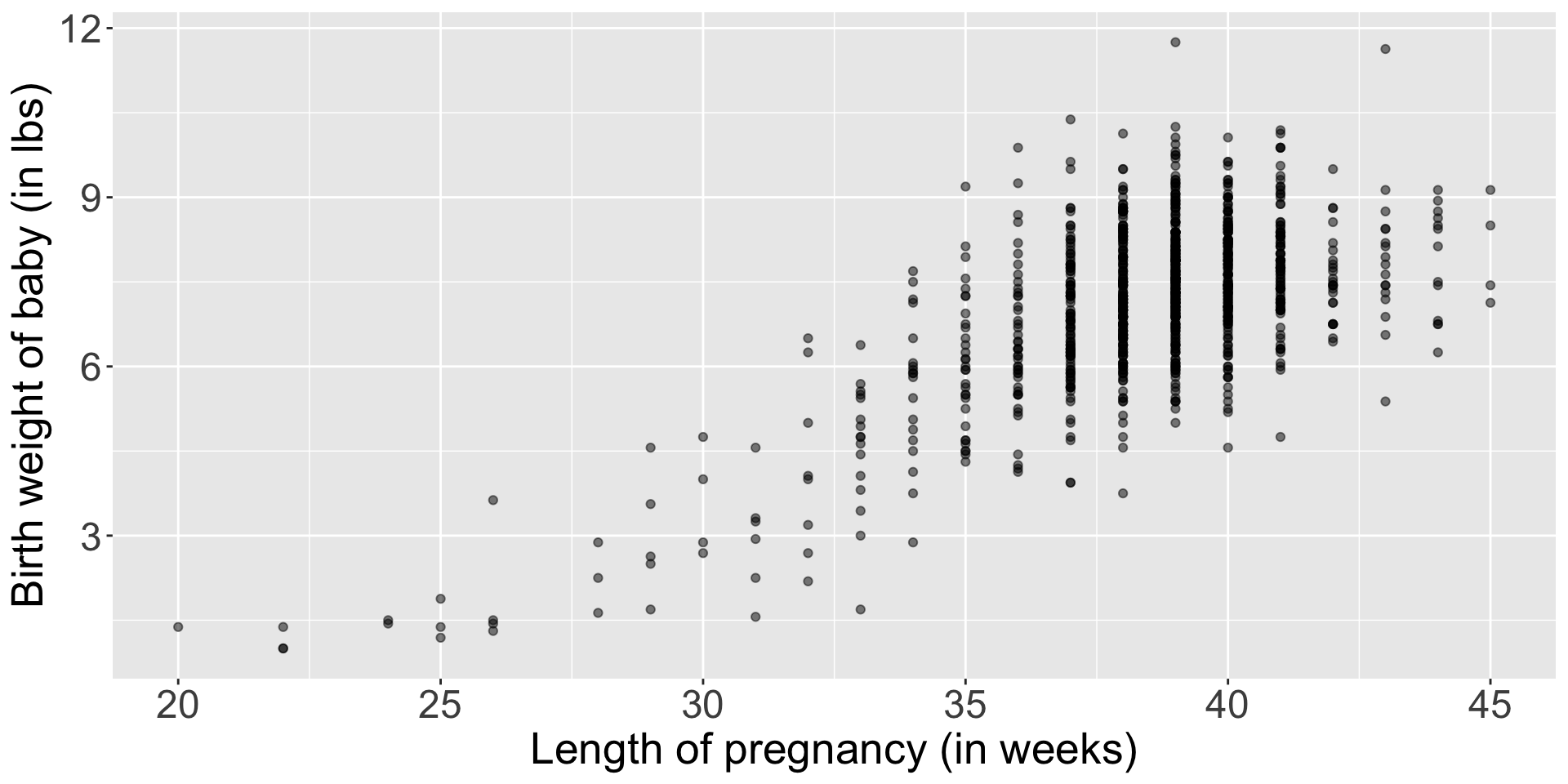
Note: Much of what we are doing at this stage involves making judgment calls!
Fitting a Model
We often assume the value of our response variable is some function of our explanatory variable, plus some random noise.
\[response = f(explanatory) + noise\]
- There is a mathematical function \(f\) that can translate values of one variable into values of another.
- But there is some randomness in the process.
Simple Linear Regression (SLR)
If we assume the relationship between \(x\) and \(y\) takes the form of a linear function…
\[ response = intercept + slope \times explanatory + noise \]
We use the following notation for this model:
Population Regression Model
\(Y_i = \beta_0 + \beta_1 X_i + \varepsilon_i\)
where \(\varepsilon \sim N(0, \sigma)\) is the random noise.
Fitted Regression Model
\(\hat{y}_i = \hat{\beta}_0 + \hat{\beta}_1 x_i\)
where \(\hat{}\) indicates the value was estimated.
Fitting an SLR Model
Regress baby birthweight (response variable) on the pregnant parent’s weight gain (explanatory variable).
- We are assuming there is a linear relationship between how much weight the parent gains and how much the baby weighs at birth.
When visualizing data, fit a regression line (\(y\) on \(x\)) to your scatterplot.
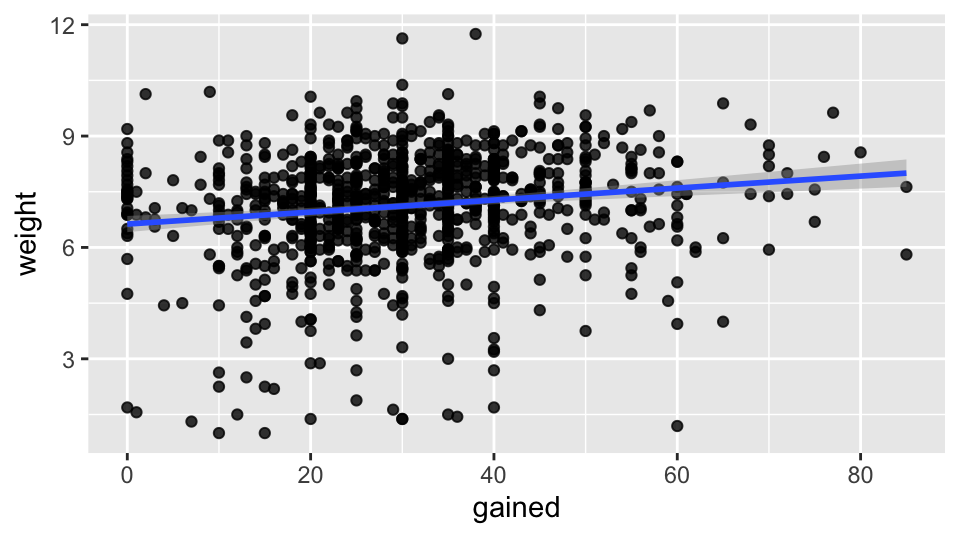
Model Outputs
Call:
lm(formula = weight ~ gained, data = ncbirths)

Residuals:
    Min      1Q  Median      3Q     Max
-6.4085 -0.6950  0.1643  0.9222  4.5158

Coefficients:
            Estimate Std. Error t value Pr(>|t|)
(Intercept)  6.63003    0.11120  59.620  < 2e-16 ***
gained       0.01614    0.00332   4.862 1.35e-06 ***
---
Signif. codes:  0 '***' 0.001 '**' 0.01 '*' 0.05 '.' 0.1 ' ' 1

Residual standard error: 1.474 on 971 degrees of freedom
  (27 observations deleted due to missingness)
Multiple R-squared:  0.02377,   Adjusted R-squared:  0.02276
F-statistic: 23.64 on 1 and 971 DF, p-value: 1.353e-06| term | estimate | std.error | statistic | p.value |
|---|---|---|---|---|
| (Intercept) | 6.6300336 | 0.1112054 | 59.619718 | 0.0e+00 |
| gained | 0.0161405 | 0.0033195 | 4.862253 | 1.4e-06 |
- Intercept: expected mean of \(y\), when \(x\) is 0.
- Someone gaining 0 lb, will have a baby weighing 6.63 lbs, on average.
- Slope: expected change in the mean of \(y\), when \(x\) increases by 1 unit.
- For each pound gained, the baby will weigh 0.016 lbs more, on average.
The difference between observed (point) and expected (line).
| .rownames | weight | gained | .fitted | .resid | .hat | .sigma | .cooksd | .std.resid |
|---|---|---|---|---|---|---|---|---|
| 1 | 7.63 | 38 | 7.243372 | 0.3866279 | 0.0013265 | 1.474586 | 0.0000458 | 0.2624942 |
| 2 | 7.88 | 20 | 6.952843 | 0.9271567 | 0.0015686 | 1.474337 | 0.0003113 | 0.6295530 |
| 3 | 6.63 | 38 | 7.243372 | -0.6133721 | 0.0013265 | 1.474506 | 0.0001152 | -0.4164381 |
Diagnostics
Model Diagnostics
There are four conditions that must be met for a linear regression model to be appropriate:
- Linear relationship.
- Independent observations.
- Normally distributed residuals.
- Equal variance of residuals.
Model Diagnostics
Is the relationship linear?
- Almost nothing will look perfectly linear.
- Be careful with relationships that have curvature.
- Try transforming your variables!
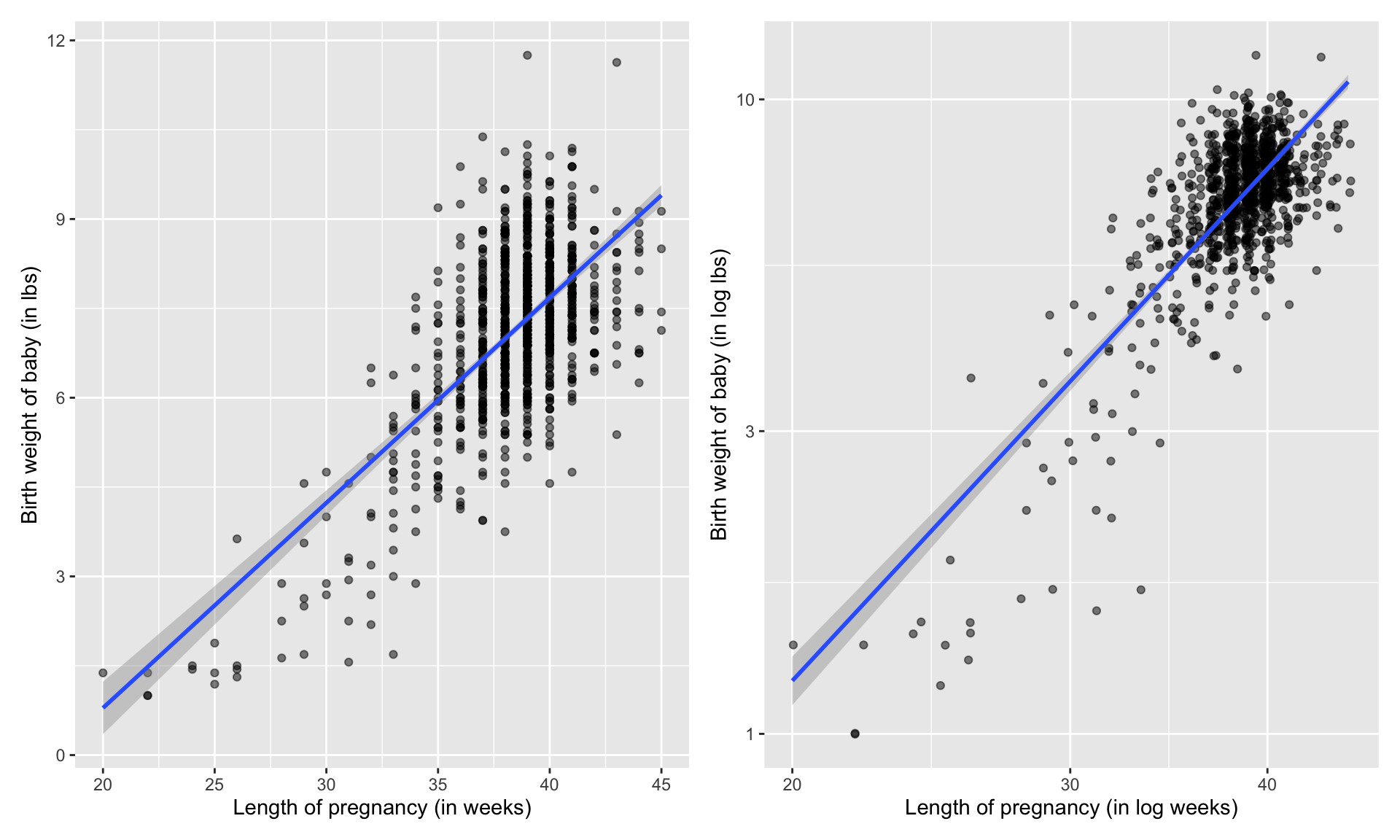
Are the observations independent? Difficult to tell!
What does independence mean?
Should not be able to know the \(y\) value for one observation based on the \(y\) value for another observation.
Independence violations:
- Stock market prices over time.
- Geographical similarities.
- Biological conditions of family members.
- Repeated observations.
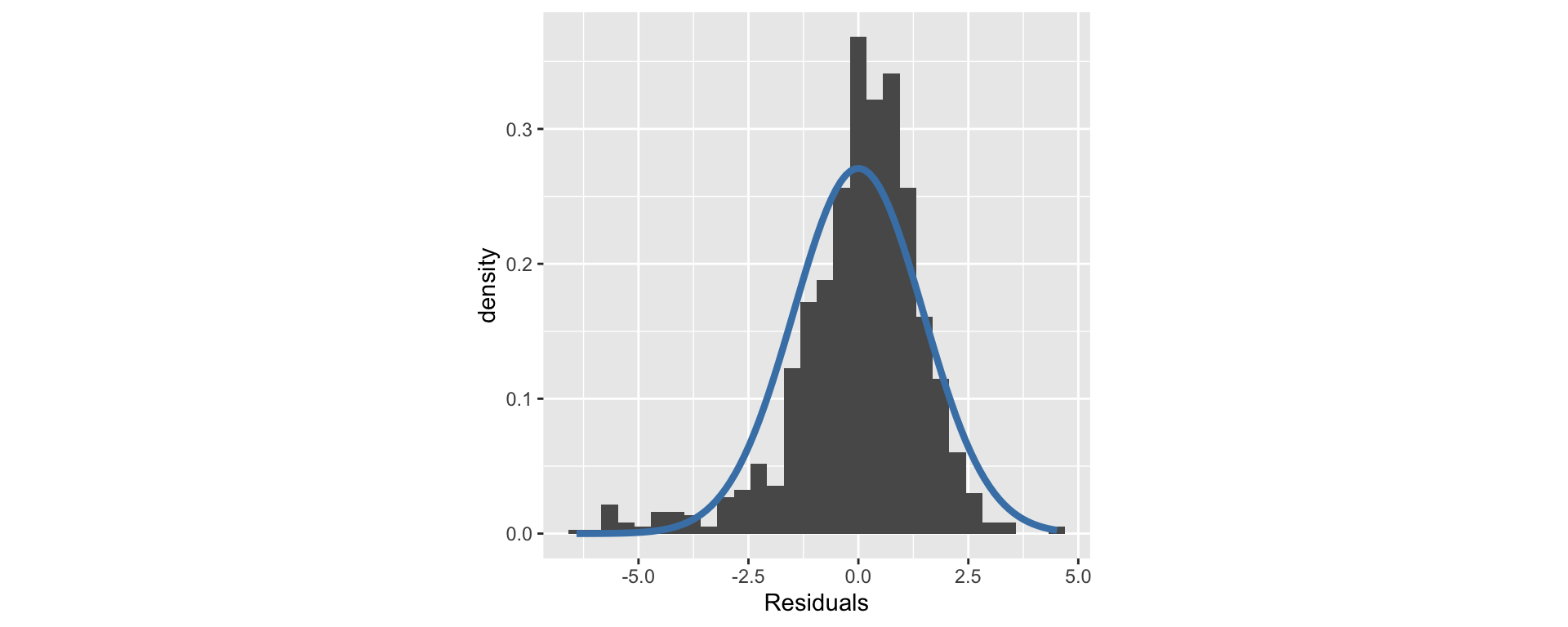
Are the residuals normally distributed?
Less important than linearity or independence:
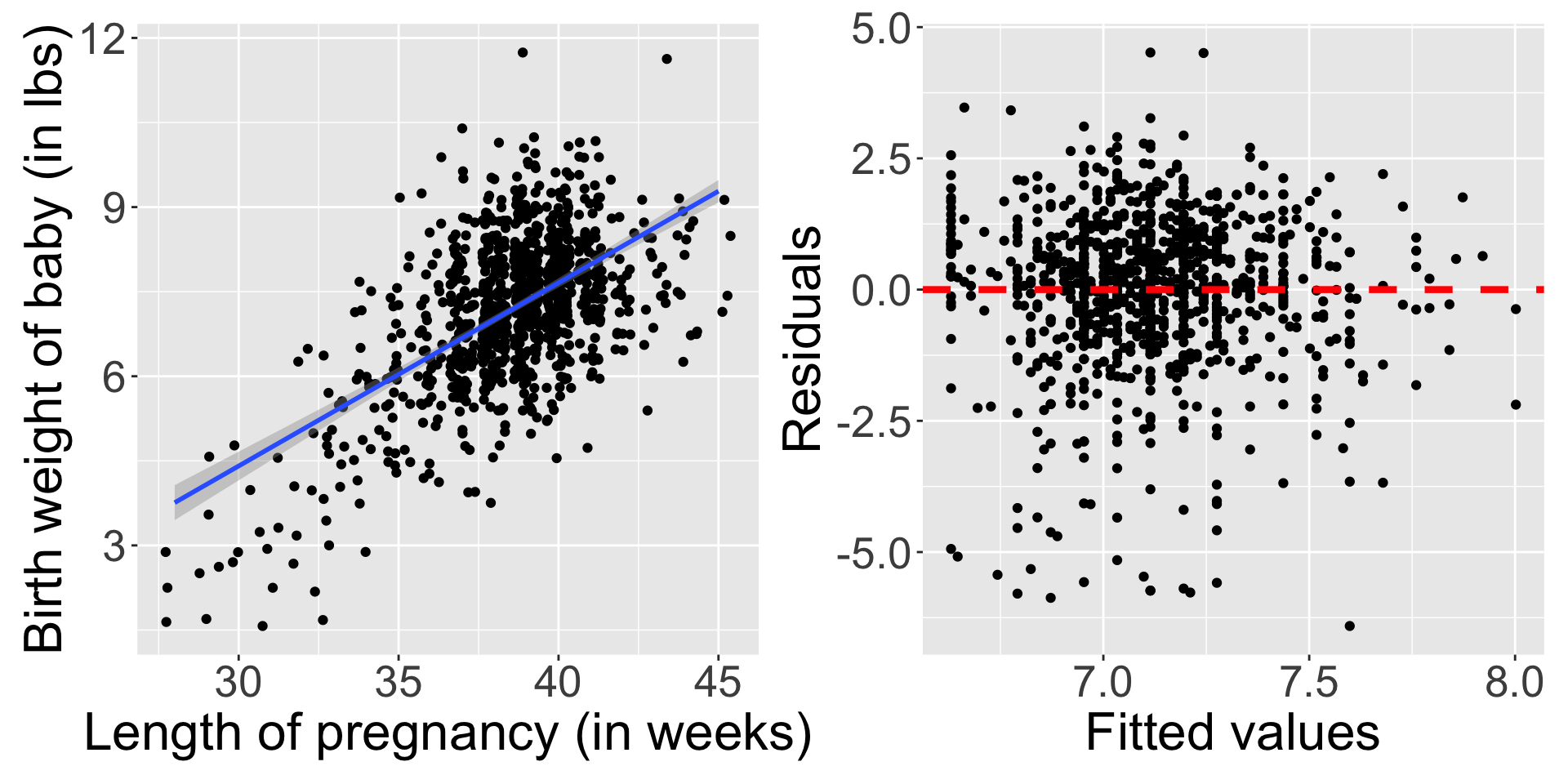
Do the residuals have equal (constant) variance?
- The variability of points around the regression line is roughly constant.
- Data with non-equal variance across the range of \(x\) can seriously mis-estimate the variability of the slope.
Assessing Model Fit
Sum of Square Errors (SSE)
- This is calculated as the sum of the squared residuals.
- A small SSE means small differences between observed and fitted values.
- Also: Sum Sq of Residuals or deviance.
Assessing Model Fit
Root Mean Square Error (RMSE)
- The standard deviation of the residuals.
- A small RMSE means small differences between observed and fitted values.
- Also: Residual standard error or sigma.
Call:
lm(formula = weight ~ gained, data = ncbirths)

Residuals:
    Min      1Q  Median      3Q     Max
-6.4085 -0.6950  0.1643  0.9222  4.5158

Coefficients:
            Estimate Std. Error t value Pr(>|t|)
(Intercept)  6.63003    0.11120  59.620  < 2e-16 ***
gained       0.01614    0.00332   4.862 1.35e-06 ***
---
Signif. codes:  0 '***' 0.001 '**' 0.01 '*' 0.05 '.' 0.1 ' ' 1

Residual standard error: 1.474 on 971 degrees of freedom
  (27 observations deleted due to missingness)
Multiple R-squared:  0.02377,   Adjusted R-squared:  0.02276
F-statistic: 23.64 on 1 and 971 DF,  p-value: 1.353e-06
Assessing Model Fit
R-squared
- The proportion of variability in response accounted for by the linear model.
- A large R-squared means the explanatory variable is good at explaining the response.
- R-squared is between 0 and 1.
Model Comparison
Regress baby birthweight on…
… gestation weeks.
- SSE = 1246.55
- RMSE = 1.119
- \(R^2\) = 0.449
Why does it make sense that the left model is better?
Multiple Linear Regression
When fitting a linear regression, you can include…
…multiple explanatory variables.
lm(y ~ x1 + x2 + x3 + ... + xn)
…interaction terms.
lm(y ~ x1 + x2 + x1:x2)
lm(y ~ x1*x2)
…quadratic relationships.
lm(y ~ I(x1^2) + x1)
Communicating Regression Model Results
- You can report the estimated linear model:
\[\hat{y}_i = 6.6 + .016x_i\]
where \(\hat{y}_i\) is the estimated birth weight in pounds and \(x_i\) is the weight gained during pregnancy by the birthing parent in pounds.
- Discuss the slope:
- Think about units that are helpful for interpretation!
- e.g.: We estimate that for every 10 pounds gained during pregnancy by the birthing parent the baby will weigh around 2.5 ounces more, on average.
Regression Table
- Commonly researchers will include a table like this to report the estimated coefficients and inference:
| Characteristic | Beta | 95% CI | p-value |
|---|---|---|---|
| (Intercept) | 6.6 | 6.4, 6.8 | <0.001 |
| gained | 0.02 | 0.01, 0.02 | <0.001 |
| Abbreviation: CI = Confidence Interval | |||
- This is a nice build-it function from an extension of the
gtpackage (gtsummary)
Putting it together: Fitting SLR On Subsets
The map2() Family
These functions allow us to iterate over two lists at the same time.
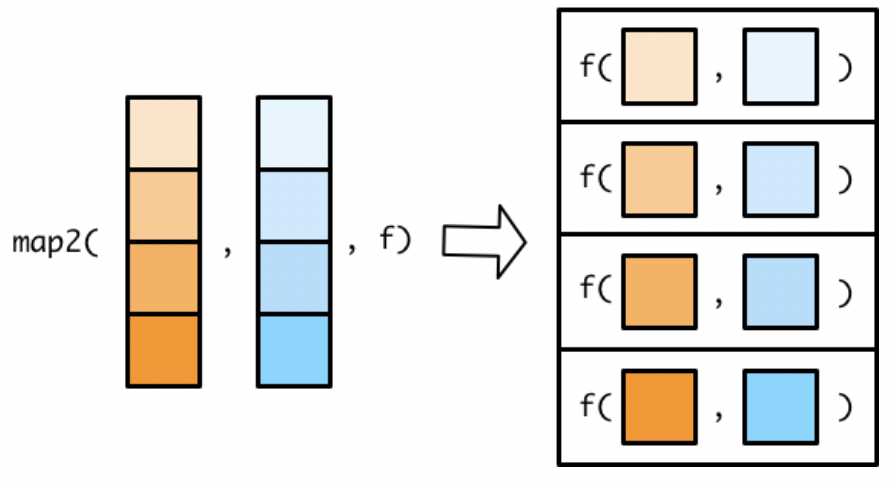
Each function has two list arguments, denoted .x and .y, and a function argument.
Small map2() Example
Find the minimum.
nest() and unnest()
- We can pair functions from the
map()family very nicely with twotidyrfunctions:nest()andunnest(). - These allow us to easily map functions onto subsets of the data.
nest()
Nest subsets the data (as tibbles) inside a tibble.
- Specify the column(s) to create subsets on.
# A tibble: 6 × 3
  premie    habit     ph_dat
  <fct>     <fct>     <list>
1 full term nonsmoker <tibble [739 × 11]>
2 premie    nonsmoker <tibble [133 × 11]>
3 full term smoker    <tibble [107 × 11]>
4 premie    smoker    <tibble [19 × 11]>
5 <NA>      nonsmoker <tibble [1 × 11]>
6 <NA>      <NA>      <tibble [1 × 11]>
unnest()
Un-nest the data by row binding the subsets back together.
- Specify the column(s) that contains the subsets.
# A tibble: 6 × 13
  premie     fage  mage mature weeks visits marital gained weight lowbirthweight
  <fct>     <int> <int> <fct>  <int>  <int> <fct>    <int>  <dbl> <fct>
1 full term    NA    13 young…    39     10 not ma…     38   7.63 not low
2 full term    NA    14 young…    42     15 not ma…     20   7.88 not low
3 full term    19    15 young…    37     11 not ma…     38   6.63 not low
4 full term    21    15 young…    41      6 not ma…     34   8    not low
5 full term    NA    15 young…    39      9 not ma…     27   6.38 not low
6 full term    NA    15 young…    38     19 not ma…     22   5.38 low
# ℹ 3 more variables: gender <fct>, habit <fct>, whitemom <fct>
Big map2() Example - Regression
# A tibble: 4 × 3
  premie    habit     ph_dat
  <fct>     <fct>     <list>
1 full term nonsmoker <tibble [724 × 11]>
2 premie    nonsmoker <tibble [126 × 11]>
3 full term smoker    <tibble [103 × 11]>
4 premie smoker <tibble [19 × 11]> # A tibble: 4 × 4
premie habit premie_smoke_dat mod
<fct> <fct> <list> <list>
1 full term nonsmoker <tibble [724 × 11]> <lm>
2 premie nonsmoker <tibble [126 × 11]> <lm>
3 full term smoker <tibble [103 × 11]> <lm>
4 premie smoker <tibble [19 × 11]> <lm> # A tibble: 4 × 5
premie habit premie_smoke_dat mod pred_weight
<fct> <fct> <list> <list> <list>
1 full term nonsmoker <tibble [724 × 11]> <lm> <dbl [724]>
2 premie nonsmoker <tibble [126 × 11]> <lm> <dbl [126]>
3 full term smoker <tibble [103 × 11]> <lm> <dbl [103]>
4 premie smoker <tibble [19 × 11]> <lm> <dbl [19]> ncbirths_clean |>
nest(premie_smoke_dat = -c(premie, habit)) |>
mutate(mod = map(premie_smoke_dat,
~ lm(weight ~ gained, data = .x)),
pred_weight = map2(.x = mod,
.y = premie_smoke_dat,
.f = ~ predict(object = .x, data = .y))) |>
select(-mod) |>
unnest(cols = c(premie_smoke_dat, pred_weight)) |>
select(premie, habit, weight, gained, pred_weight) |>
head()# A tibble: 6 × 5
premie habit weight gained pred_weight
<fct> <fct> <dbl> <int> <dbl>
1 full term nonsmoker 7.63 38 7.55
2 full term nonsmoker 7.88 20 7.43
3 full term nonsmoker 6.63 38 7.55
4 full term nonsmoker 8 34 7.53
5 full term nonsmoker 6.38 27 7.48
6 full term nonsmoker 5.38 22 7.44Example Cont. - Regression Coefficients
# A tibble: 4 × 5
premie habit premie_smoke_dat mod coefs
<fct> <fct> <list> <list> <list>
1 full term nonsmoker <tibble [724 × 11]> <lm> <tibble [2 × 5]>
2 premie nonsmoker <tibble [126 × 11]> <lm> <tibble [2 × 5]>
3 full term smoker <tibble [103 × 11]> <lm> <tibble [2 × 5]>
4 premie smoker <tibble [19 × 11]> <lm> <tibble [2 × 5]># A tibble: 8 × 7
premie habit term estimate std.error statistic p.value
<fct> <fct> <chr> <dbl> <dbl> <dbl> <dbl>
1 full term nonsmoker (Intercept) 7.29 0.0965 75.5 0
2 full term nonsmoker gained 0.00705 0.00285 2.48 1.34e- 2
3 premie nonsmoker (Intercept) 4.55 0.393 11.6 1.75e-21
4 premie nonsmoker gained 0.0258 0.0137 1.89 6.09e- 2
5 full term smoker (Intercept) 6.77 0.223 30.3 1.71e-52
6 full term smoker gained 0.0121 0.00613 1.98 5.08e- 2
7 premie smoker (Intercept) 5.75 0.880 6.54 5.04e- 6
8 premie smoker gained -0.0320 0.0293 -1.09 2.89e- 1Code
ncbirths_clean |>
  nest(premie_smoke_dat = -c(premie, habit)) |>
  mutate(mod = map(premie_smoke_dat,
                   ~ lm(weight ~ gained, data = .x)),
         coefs = map(mod,
~ broom::tidy(.x))) |>
select(premie, habit, coefs) |>
unnest(cols = coefs) |>
mutate(term = fct_recode(.f = term,
"Intercept" = "(Intercept)",
"Mother Weight Gain (lb.)" = "gained"
)) |>
select(-std.error, -statistic) |>
mutate(p.value = case_when(p.value < .0001 ~ "<.001",
TRUE ~ as.character(round(p.value, 3)))) |>
arrange(premie, habit, term) |>
gt() |>
fmt_number(estimate,
decimals = 3) |>
tab_row_group(
label = md("**Premature + Smoker**"),
rows = premie == "premie" & habit == "smoker") |>
tab_row_group(
label = md("**Premature + Non-Smoker**"),
rows = premie == "premie" & habit == "nonsmoker") |>
tab_row_group(
label = md("**Full Term + Smoker**"),
rows = premie == "full term" & habit == "smoker") |>
tab_row_group(
label = md("**Full Term + Non-Smoker**"),
rows = premie == "full term" & habit == "nonsmoker") |>
cols_hide(c(premie, habit)) |>
cols_align(align = "left",
columns = term) |>
tab_style(
style = cell_fill(color = "gray85"),
locations = cells_row_groups()) |>
cols_label(
"term" = md("**Model & Term**"),
"estimate" = md("**Est. Coef.**"),
"p.value" = md("**p-value**")
) | Model & Term | Est. Coef. | p-value |
|---|---|---|
| Full Term + Non-Smoker | ||
| Intercept | 7.285 | <.001 |
| Mother Weight Gain (lb.) | 0.007 | 0.013 |
| Full Term + Smoker | ||
| Intercept | 6.767 | <.001 |
| Mother Weight Gain (lb.) | 0.012 | 0.051 |
| Premature + Non-Smoker | ||
| Intercept | 4.549 | <.001 |
| Mother Weight Gain (lb.) | 0.026 | 0.061 |
| Premature + Smoker | ||
| Intercept | 5.754 | <.001 |
| Mother Weight Gain (lb.) | −0.032 | 0.289 |
Lab 9: Regression Exploration
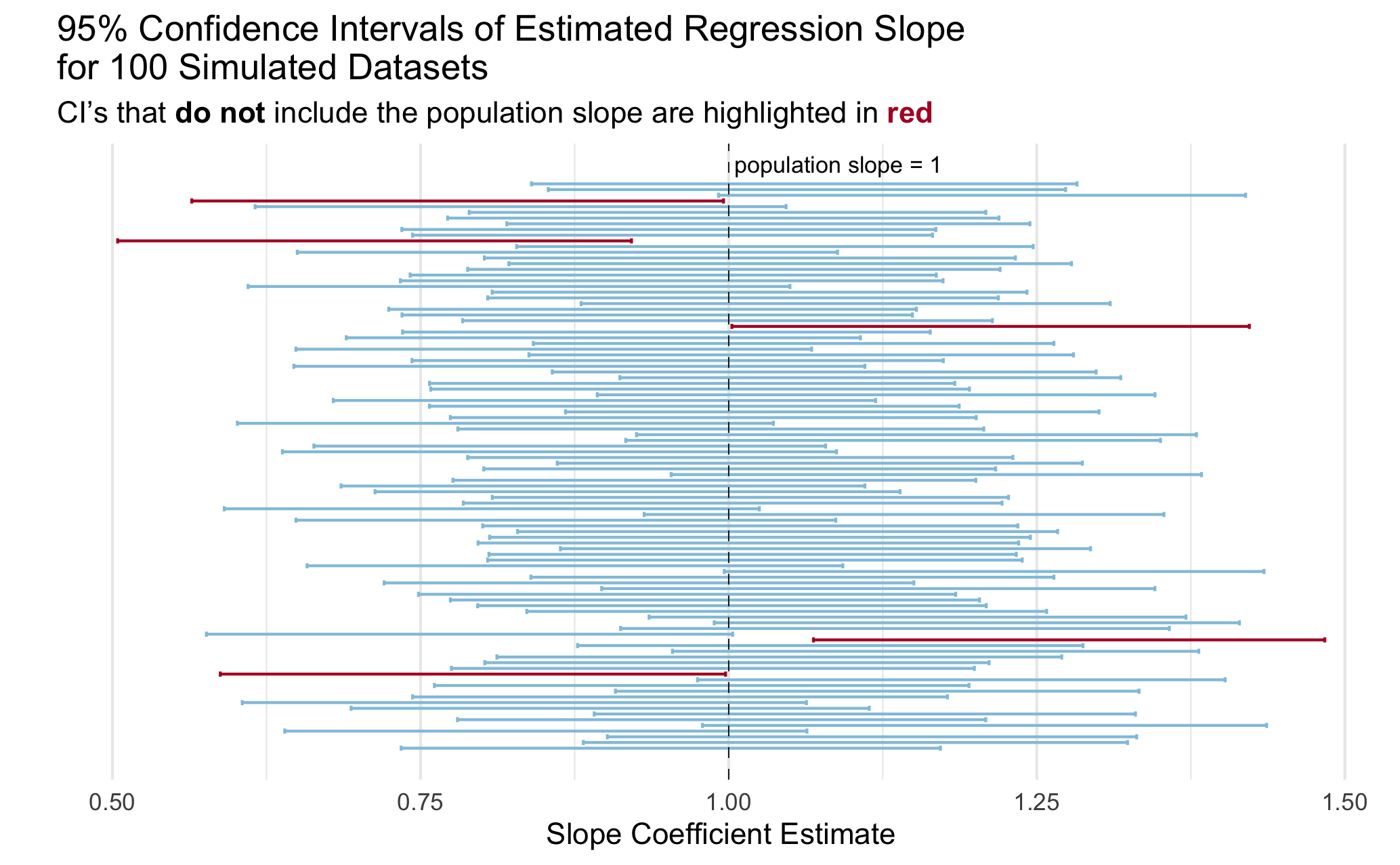
To do…
- Optional Project Checkpoint 4
- Due Friday 5/29 at 11:59pm.
- Lab 9: Simulation Exploration
- Due Tuesday 6/2 at 11:59pm.
- Required Reading
- Review the material from this week for the final Group Quiz Monday